

Sing a Song of Sixpence
If you have ever seen my workroom when I am in the middle of making a bird you would know how messy I am – blaming it on only having a tiny space to make wool birds in. There are whisps of wool across my desk, half-full marmalade jars of cloudy water thick with paintbrushes, and sketchbooks, notebooks and bird books strewn across all the remaining space. So it should not surprise you to learn I am a bit of a messy thinker too.
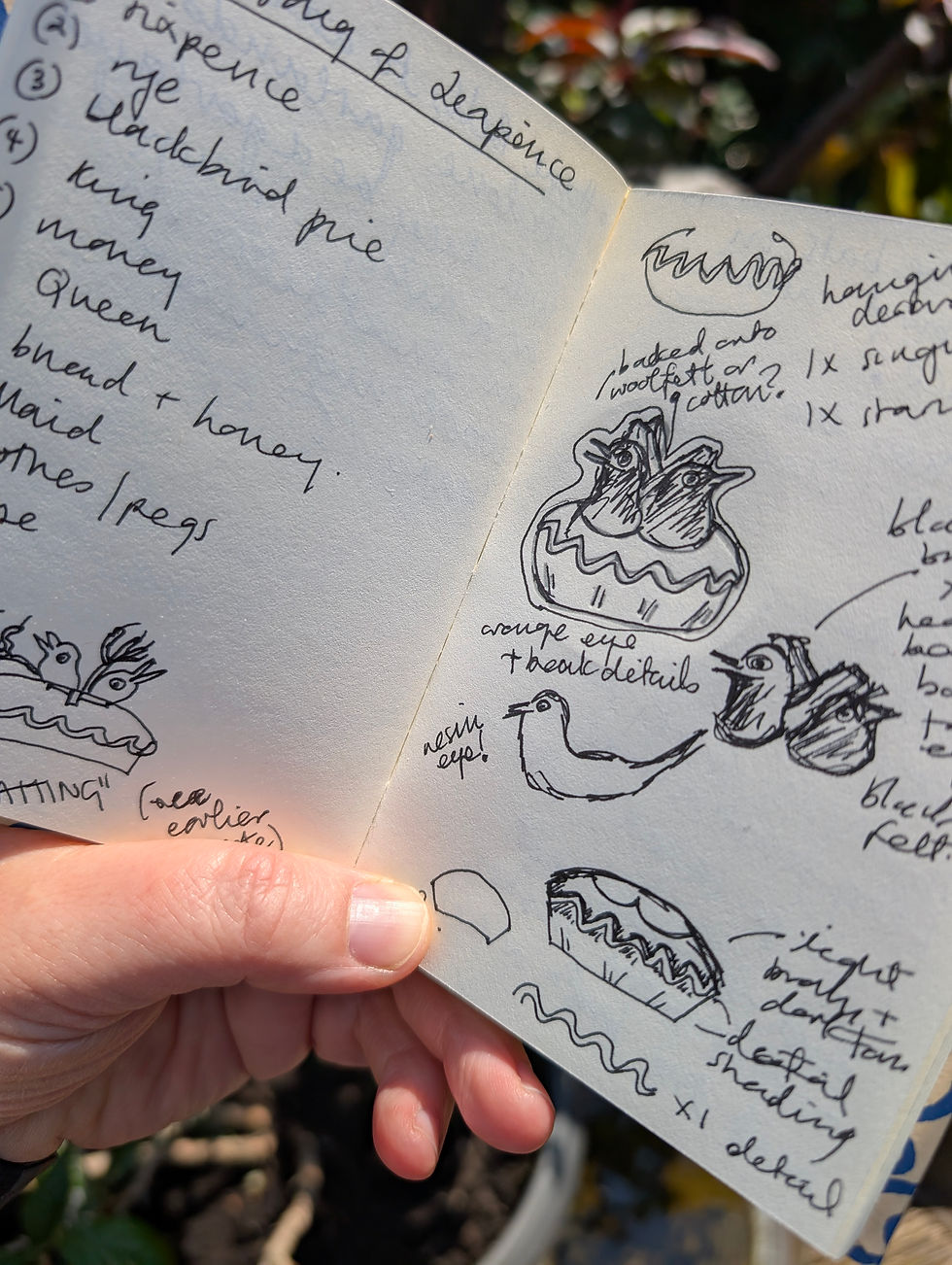
This has become much worse since I developed long-covid, and it is for this reason that I keep an ‘ideas’ notebook on me at all times. I am allowed to scribble, spell badly and generally make a mess in this book despite the fact it is a handmade note book (by @Bindfulness you can find her on Insta) with beautiful cats on the cover (picture provided). My ideas wander in this little book and so it was that the Blackbird Pies developed in a very meandering way starting back in winter 2024.
I note a wonderful moment back then, with a male blackbird who ignored copious crabapples and instead threw about the mulch on the plant pots looking for invertebrates. I was gently playing carols on my recorder at the time – do you remember those black, plastic recorders we all used to play in ‘music’ lessons at one time in UK schools? - and it struck me that the blackbird and my treble recorder were both black and shiny and that both made rich, fluty notes and screeched with alarm from time to time. The blackbird seemed to like the lower register, cocking its head to listen, but flew angrily off when I played an upper-register A. I ask in my notes do birds have to practice singing, do they fumble the sharps and flats and get the notes wrong and, if they do, would we know?
Blackbirds are back a few days later under the heading Bird Batting, the very old practice of catching garden birds by lantern light at night in nets to eat. Mentioned by Shakespeare in The Tempest (1611), Webster in The Duchess of Malfi (1614), it is easiest understood using the description of Henry Fielding from Joseph Andrews (1742), Bk. II, ch. 10, p. 230:
“These People who now approached were no other, Reader, than a Set of young Fellows, who came to these Bushes in pursuit of a Diversion which they call Bird-batting. This, if thou art ignorant of it (as perhaps if thou hast never travelled beyond Kensington, Islington, Hackney, or the Borough, thou mayst be) I will inform thee, is performed by holding an large Clap-Net before a Lanthorn, and at the same time, beating the Bushes: for the Birds, when they are disturbed from their Places of Rest, or Roost, immediately make to the Light, and so are enticed within the Net.”
To bring us back to the blackbirds, this is when I first had the idea to remind us all of this cruel sport by making a Blackbird Pie. I noted that blackbird pie was eaten at Christmas using the breast and leg meat (though Margaret Sim’s Cookery Book [1879] disagrees and uses whole stuffed blackbirds in her recipe) and that bird batting was still happening right up until World War 1(1914). I’d read a description somewhere that the birds when caught were tied together by their legs – verified later by this quote from Samuel Butler’s poem Hudibras (1663) ‘Some with a noyse, and greasy light, Are snapt, as men catch larks at night; Ensnar’d and hamper’d by the soul, as noozes by the Legs catch Foul.’
A raised pie crust would, so I write and draw, ‘have the feet tied into a little bundle and sticking out together as decoration’ from the hole in the top of the pie. What a wonderfully gruesome idea and, to be honest, I still might make one of these for myself as I quite like the little sketch I added, which looks like a tropical island missing its Robinson Crusoe!

I looked back at this much earlier series of notes I’d made in February this year, when I’d been remembering the nursery rhyme I had loved so much as a child ‘Sing a Song of Sixpence’. It struck me that the sight of realistic bird feet bundled in string might not be as appealing as the sight of their faces coming out of a pie, especially if at least one of them was singing. I did another little sketch that included singing heads alongside sticking out at weird angles feet, then modified that to just the heads and the song. It was apparent immediately that I would need to make ‘four and twenty’ blackbirds or 24 pies to reprieve the refrain from the rhyme, and so the use of felt sheets and needle felted details was expedient in order to avoid them being very time-consuming and therefore expensive. And so a serious historical subject tackled with a sweet and funny handmade bird decoration is fast becoming a trademark!
However, I think I made one very silly mistake, which may have made an ass out of u and me!
I love the rhythm and rhyming of these hand-me-down poems, and the image of a maid having her nose pecked off at the end of Sing a Song of Sixpence was my absolute favourite part. My dad used to do that trick of making you think your nose had been swiped into his cupped hands by the clever placement of a thumb (how did any of us ever fall for that), and the feeling of delightful terror was bound together with that deliciously terrifying maid-maiming blackbird.
So I assumed everyone would remember this rhyme just as I did. I had done a little bit of checking – I had asked my children when I made the prototype what they thought it referred to and they both got it. Sadly, this very partial and select cross section of society (who had nursery rhymes sung to them by their excitable Dickensian mother) proved not to be indicative of the rest of the bird arts loving population. I am still hoping that you might be as surprised as me to know that very few people, who recently visited for an artists’ open house event here, knew the words of Sing a Song of Sixpence or any of the imagery. Oh dear!
This was a huge problem as I had not explained the unwittingly subtle window display of Blackbird Pies any more than by adding huge painted sixpences hanging around them. I thought this was a pretty obvious reference but the blank-faced responses to the pie dish, floured rolling pin and woollen pies on offer on my front room table told a very different story. The fact I had included a real sixpence in a gift box with a tiny lino print of the pie seemed to confuse people even more.

So, I quickly printed out the information below for my guests:
Sing a song of sixpence
A pocket full of rye;
Four and twenty blackbirds,
Baked in a pie.
When the pie was opened,
The birds began to sing;
Was not that a dainty dish,
To set before the king?
The king was in his counting-house,
Counting out his money;
The queen was in the parlour,
Eating bread and honey.
The maid was in the garden,
Hanging out the clothes,
There came a little blackbird,
And snapped off her nose.
Attributed to George Steevens 1790 due to a witty joke he made in answer to a birthday poem written by the then poet laureate in honour of his king’s birthday. However, earlier versions of the rhyme appear in ‘toy literature’ and there are allusions in Shakespeare’s Twelfth Night and a play by Beaumont and Fletcher in 1614.
It is likely the rhyme actually refers to a popular entertainment where birds were baked still alive into pies to fly loose once the pie was cut open and flap about in the candle lit dining room. This is first described in an Italian cook book in 1549 but is referred to in later texts as if it was a practice of old.
My Blackbird Pie decorations are all baked ready for you to savour!
This special edition of four and twenty pies are a limited gift box edition, made especially for the WAM trail, including a limited first edition tiny print of a blackbird pie and real vintage sixpence adorning a hand painted tiny crown!
Given this grievous error, I actually spent much of the time explaining the basics of the nursery rhyme to my guests and did not have a chance to bring in any of the deep rooted information on bird batting at all. Luckily several younger adults (and older adults buying for grown up children too) thought the pies were adorable without knowing anything more about them at all.
In the Blackbird Pie we have a subversion of the natural order of our food and eating. Where typically the birds would be caught in the net and batted to death, defeathered and cleaned, cooked in the pie and eaten, in the rhyme they enter the pie alive and are freed to fly and sing and reek their revenge at being caught after the crust of the pie is cut for consumption. The birds power is in their voices and their wings - they escape the palace, leaving the king caged in his counting house and the queen in her pretty parlour-cage and maiming the maid who has dared to trespass outside. The blackbirds inherit the earth and all it holds, as is their right.
Or we just have a quirky bit of a nonsense poem as a wool-felt bird decoration and I’ll leave you with the smell of fresh-baked pastry, bird song and my open shop.


Comments